Birch
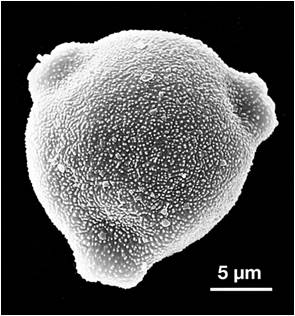 Scanning electron microscopy — Source: Red Palinocam, Comunidad de Madrid
 Description
The genus Betula (family Betulaceae) includes B. pendula (silver birch) and B. pubescens (downy birch). Slender deciduous trees of 10-25 m, recognizable by their white papery bark that peels in strips. Leaves are simple, alternate, rhomboidal to triangular, doubly serrate. Monoecious with pendant cylindrical male catkins and erect shorter female catkins that disintegrate when ripe, releasing tiny winged fruits.
Habitat and distribution
Rare naturally in Madrid, found only in the coolest, most humid enclaves of the northern sierra. However, widely planted as ornamentals in parks and residential areas, especially in northwestern Madrid (Las Rozas, Pozuelo, Boadilla).
Health impact
Pollination March-May. Low ambient concentrations in Madrid, but enough to trigger symptoms in previously sensitized individuals. Major allergen Bet v 1 causes oral allergy syndrome (OAS) with raw fruits. Produces intense rhinoconjunctivitis with profuse rhinorrhea and bilateral conjunctivitis.
Cross-reactivity
High cross-reactivity with alder, hazel and hornbeam (all Betulaceae). Birch-apple syndrome: PR-10 protein (Bet v 1) is homologous to apple (Mal d 1), pear, cherry, peach, hazelnut, carrot and celery proteins. Patients tolerate cooked fruits as heat denatures the allergen.
Pollen morphology
Triporate pollen grain, oblate-spheroidal, 20-28 μm. Operculate, slightly protruding pores. Finely granular surface. Exine 1.5-2 μm with thickened endexine around pores. Distinguished from alder by absence of arches between pores.
Did you know?
Birch-apple syndrome affects millions in Northern Europe. Patients feel mouth itching when eating raw apple, pear or cherry, but tolerate cooked versions. Birch sap is traditionally collected in Nordic countries as a spring tonic drink.
The information on this page is for educational purposes. For any questions about allergies, consult your doctor or allergist.