Alder
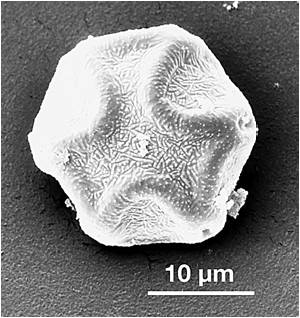 Scanning electron microscopy — Source: Red Palinocam, Comunidad de Madrid
 Description
The genus Alnus (family Betulaceae) includes common alder (A. glutinosa) in Madrid. A deciduous tree of 10-25 m with straight trunk and gray-brown bark. Leaves are simple, alternate, suborbicular to obovate, glutinous (sticky) when young. Monoecious: long pendant brownish-red male catkins; short erect female catkins that become woody cone-like structures persisting on the tree.
Habitat and distribution
Strictly riparian, requiring permanently moist soils. In Madrid, forms alder groves along the Lozoya, Guadarrama, upper Manzanares and other sierra rivers and streams.
Health impact
Winter pollination (January-March), peaking February. Moderate allergenicity, relevant due to Betulaceae membership. Aln g 1 allergen is homologous to birch Bet v 1. Produces rhinoconjunctivitis with sneezing, watery nasal congestion and ocular itching. Patients may also experience oral allergy syndrome with apples, cherries and hazelnuts.
Cross-reactivity
Significant cross-reactivity with birch (Betula), hazel (Corylus) and hornbeam (Carpinus), all Betulaceae, through group 1 allergen homology.
Pollen morphology
Periporate pollen grain with 4-5 pores (rarely 3 or 6), oblate-spheroidal, 20-28 μm. Pores connected by thickened exine arches (aspidia), a very characteristic genus feature. Granular surface. Exine 1.5-2 μm.
Did you know?
Alder improves soil through symbiotic nitrogen-fixing bacteria (Frankia) in root nodules, making it a natural fertilizer of riparian soils. Its wood hardens underwater: Venice's piles are partly made of alder wood.
The information on this page is for educational purposes. For any questions about allergies, consult your doctor or allergist.