Goosefoot/Amaranth
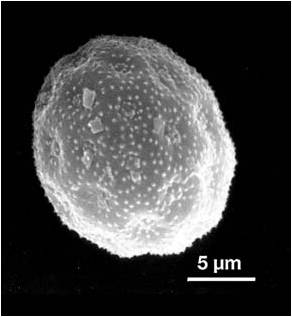 Scanning electron microscopy — Source: Red Palinocam, Comunidad de Madrid
 Description
The Chenopodiaceae and Amaranthaceae families (now unified as Amaranthaceae sensu lato) include goosefoot (Chenopodium), amaranth (Amaranthus), saltwort (Salsola) and wild beet. Goosefoot species are annual or perennial, farinose (whitish glands), with alternate petiolate leaves and panicle inflorescences of hermaphrodite flowers with 5 tepals and 0-5 stamens. Amaranths have axillary glomerulate inflorescences with unisexual flowers.
Habitat and distribution
Nitrophile wild plants colonizing rubble, roadsides, cultivated fields on dry soils in Mediterranean climate. Common in the driest areas of southern and southeastern Madrid. Pioneer species on disturbed ground.
Health impact
Pollination June-November. Produces rhinoconjunctivitis and can worsen asthma. Important allergen in arid areas of southern Spain and the eastern Mediterranean. Relevance increases in dry, hot summers.
Cross-reactivity
Cross-reactivity within the family (Chenopodium-Amaranthus-Salsola). Main allergen is Che a 1.
Pollen morphology
Apolar, spheroidal pollen grain, 20-29 μm, pantoporate with 25+ circular pores of 1.7 μm in tectal depressions, granular apertural membrane, often with annular thickening. Complete tectum with supratectal spines/granules <0.2 μm in rugulate arrangement.
Did you know?
Salsola kali is the desert tumbleweed that disperses seeds and pollen as it rolls in the wind. Goosefoot gets its name from the whitish, mealy coating that covers its leaves.
The information on this page is for educational purposes. For any questions about allergies, consult your doctor or allergist.