Cypress/Yew
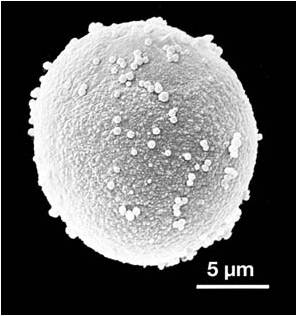 Scanning electron microscopy — Source: Red Palinocam, Comunidad de Madrid
 Description
The Cupressaceae family includes cypresses (Cupressus), Arizona cypresses (Cupressus arizonica), thujas (Platycladus orientalis) and junipers (Juniperus). The common cypress (C. sempervirens) can reach 35 m with its distinctive columnar shape. The Arizona cypress, native to North America, has become the most widely planted ornamental conifer in the Madrid region, especially as hedging. The prickly juniper (Juniperus oxycedrus) grows wild and reaches about 10 m. In the Community of Madrid, the Arizona cypress is the most widespread species and the main source of allergenic pollen during winter.
Habitat and distribution
Widely planted in parks, gardens, cemeteries and as dividing hedges in residential areas. The Arizona cypress is the most planted conifer in the Madrid region. Also naturally present in mountain areas (junipers, savin junipers). Platycladus orientalis is common in public and private gardens.
Health impact
They cause winter pollinosis (December-March), with rhinoconjunctivitis symptoms and, in severe cases, asthma. Cypresses flower from December to March, while Platycladus concentrates its flowering in February. The Arizona cypress produces massive amounts of pollen: a single tree can release millions of grains. It is the first cause of pollinosis in Madrid by calendar, as it is the first allergenic pollen of the year.
Cross-reactivity
Cross-reactivity exists among all Cupressaceae, especially through the Cup a 1 protein. There may also be cross-reactivity with Japanese cedar (Cryptomeria japonica).
Pollen morphology
Heteropolar, spheroidal pollen grain, 22-28 μm in Cupressus and slightly smaller in Juniperus. Inaperturate or with a diffuse germinal zone. Star-shaped cytoplasm and thick gelatinous intine visible under microscopy. Characteristic "golf ball" appearance.
Did you know?
Cupressaceae produce one of the most abundant pollens in the Iberian Peninsula. On dry, windy winter days, true "yellow clouds" of pollen can be seen detaching from Arizona cypress hedges. The thick gelatinous intine helps the grain hydrate rapidly upon contact with nasal mucosa, contributing to its high allergenic potential.
The information on this page is for educational purposes. For any questions about allergies, consult your doctor or allergist.