Ash
 Scanning electron microscopy — Source: Red Palinocam, Comunidad de Madrid
 Description
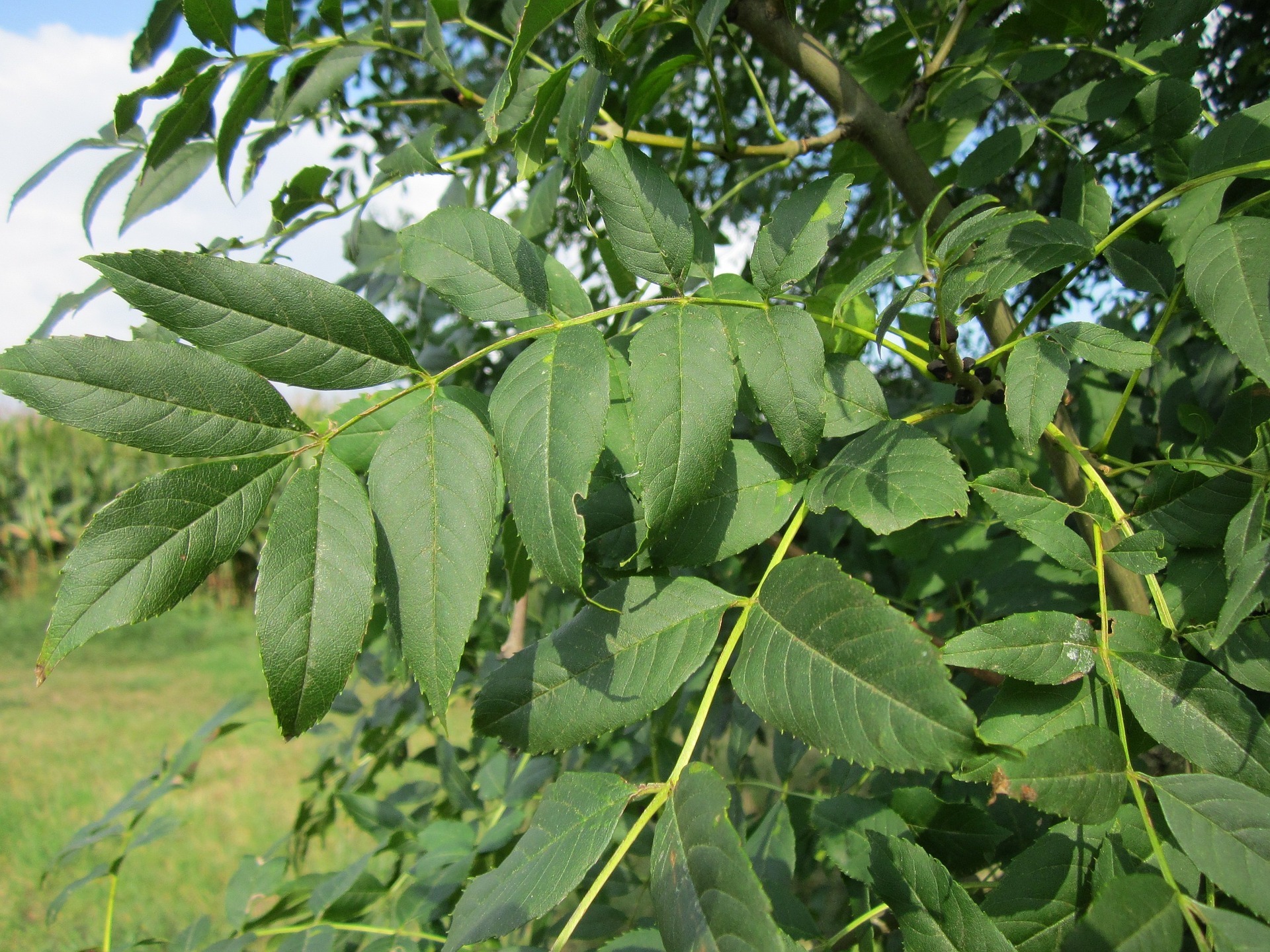
The narrow-leaved ash (Fraxinus angustifolia Vahl) is the main species in Madrid. It is a deciduous tree of 10-15 m with a straight trunk and finely fissured gray bark. Leaves are opposite, imparipinnate, with 3-5 pairs of lanceolate leaflets. Flowers appear before leaves in opposite racemes. The plant may be dioecious or bisexual, with 2 stamens and a bifid stigma. The fruit is a winged samara.
Habitat and distribution
Requires deep humid soils: riverbanks, valley bottoms with high water table. In Madrid, abundant in parks like El Retiro and Casa de Campo, and along watercourses in the sierra foothills.
Health impact
Winter pollination (December-February), very early compared to other trees. Produces rhinoconjunctivitis that may be confused with a winter cold. Important due to cross-reactivity with olive.
Cross-reactivity
High cross-reactivity with olive (Olea), privet (Ligustrum) and lilac (Syringa). The ash-olive-privet syndrome is the most clinically relevant among Oleaceae in Madrid.
Pollen morphology
Isopolar, radially symmetrical, suboblate to spheroidal pollen grain, 18-23 μm, trizonocolporate with long narrow apertures. Partial tectum, reticulate with irregular lumina of 1.2-1.3 μm. Exine approximately 2 μm.
Did you know?
Ash trees flower in mid-winter before leafing out, allowing unobstructed pollen dispersal. Ash groves are one of the most characteristic landscapes of the Madrid sierra foothills.
The information on this page is for educational purposes. For any questions about allergies, consult your doctor or allergist.