Grasses
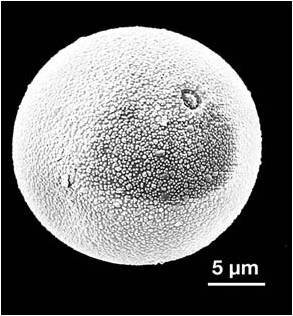 Scanning electron microscopy — Source: Red Palinocam, Comunidad de Madrid
 Description
Grasses (family Poaceae) are the largest family of flowering plants, with over 12,000 species. They are annual or perennial herbs with hollow cylindrical stems and distichous alternate leaves with a ligule. Flowers are typically hermaphrodite, grouped in spikelets forming panicles, with 3 stamens each. They include cereals (wheat, barley, oats, corn, rice), ornamental lawns (Lolium, Festuca, Poa), wild pastures and reeds (Phragmites). They are the most important cause of pollinosis worldwide.
Habitat and distribution
Ubiquitous in the Community of Madrid: natural meadows, roadsides, abandoned plots, parks with lawns, agricultural fields and pastures. Especially abundant in periurban and rural areas of the south and east.
Health impact
Responsible for most spring pollinosis (April-July). They produce severe rhinoconjunctivitis, bronchial asthma, and in extreme cases laryngeal edema. About 15-20% of the general population is sensitized.
Cross-reactivity
High cross-reactivity exists among different grass species (Lolium, Phleum, Dactylis, Festuca...) as they share allergen groups 1, 5 and 13.
Pollen morphology
Monoporate, spheroidal pollen grain, 30-50 μm in wild species. Cultivated grasses produce much larger grains: corn (Zea mays) reaches 90-100 μm. Single pore with operculum and annular thickening. Tectate surface with granular or verrucose supratectal relief.
Did you know?
Grasses produce pollen all year, but the peak is concentrated in May-June in Madrid. Thunderstorms can break pollen grains into smaller particles that penetrate deeper into the bronchi, a phenomenon known as "thunderstorm asthma".
The information on this page is for educational purposes. For any questions about allergies, consult your doctor or allergist.