Mulberry
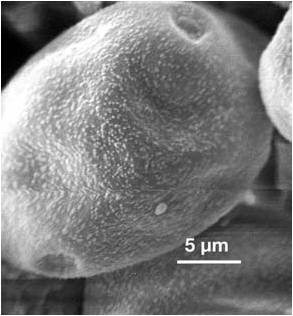 Scanning electron microscopy — Source: Red Palinocam, Comunidad de Madrid
 Description
The Moraceae family includes mulberries (Morus alba, M. nigra) and fig trees (Ficus carica). White mulberry is a deciduous tree of 8-15 m with rounded crown, alternate ovate leaves with irregularly toothed margins, and small greenish flowers in pendant catkins. The compound fruit (mulberry) is juicy, white-pink in M. alba and purple-black in M. nigra. Fig trees have large, rough, palmate leaves and flowers hidden inside the fleshy receptacle (syconium) that ripens into a fig.
Habitat and distribution
Mulberries planted as shade trees in parks, avenues and squares throughout Madrid, especially in southern and eastern towns. Fig trees in gardens, orchards, wasteland and warm rocky outcrops; also naturalized on walls and ruins. Both tolerate Madrid's summer heat and drought well.
Health impact
Pollination March-May, peaking April. Low-moderate allergenicity. Mulberry is wind-pollinated with appreciable pollen output, while fig is partially insect-pollinated. Can cause rhinoconjunctivitis with sporadic sneezing, watery rhinorrhea and nasal itching. Some patients may develop food allergy to mulberries or figs through cross-sensitization.
Cross-reactivity
Possible cross-reactivity within the family and with Urticaceae. Fig may cause oral allergy syndrome in patients sensitized to Moraceae pollen or with latex allergy.
Pollen morphology
Diporate to triporate pollen grain, spheroidal to slightly oblate, 15-20 μm. Small pores sometimes with slight annular thickening. Granular to finely spinulose surface. Thin exine of approximately 1 μm. Small size makes counting difficult in volumetric samplers.
Did you know?
White mulberry was the main food of the silkworm (Bombyx mori), a major industry in Spain for centuries. The fig tree is one of the first domesticated trees, with cultivated fig remains dated over 11,000 years ago in the Jordan Valley.
The information on this page is for educational purposes. For any questions about allergies, consult your doctor or allergist.