Elm
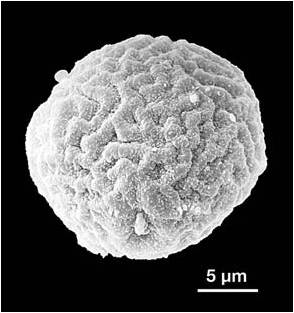 Scanning electron microscopy — Source: Red Palinocam, Comunidad de Madrid
 Description
The genus Ulmus (family Ulmaceae) includes common elm (U. minor), mountain elm (U. glabra) and Siberian elm (U. pumila). Majestic deciduous trees reaching 25-30 m with wide rounded crowns. Leaves are simple, alternate, asymmetrical at the base, doubly serrate. Bisexual flowers appear before leaves in clusters. Fruit is an orbicular samara with the wing surrounding the central seed.
Habitat and distribution
Naturally along riverbanks and fertile valley floors. Traditionally planted in urban parks and avenues. In Madrid, most historic elms have been lost to Dutch elm disease. Resistant varieties are being replanted.
Health impact
Very early pollination (January-March). Low allergenicity overall, rarely a primary sensitizer. In polysensitized patients it may contribute to winter symptoms with mild rhinoconjunctivitis and moderate nasal congestion.
Cross-reactivity
Little documented cross-reactivity with other pollen types. No clinically relevant cross-reactivity syndromes known.
Pollen morphology
Periporate pollen grain with 4-5 pores (rarely 6), spheroidal, 28-35 μm. Operculate pores. Rugulate to granular surface. Relatively thick exine, 2-2.5 μm. Distinguished by large size and multiple pores.
Did you know?
Dutch elm disease, caused by the fungus Ophiostoma novo-ulmi spread by bark beetles, has been one of the greatest forest epidemics in history since the 1980s. Resistant varieties are now being replanted across Madrid.
The information on this page is for educational purposes. For any questions about allergies, consult your doctor or allergist.