Plantain
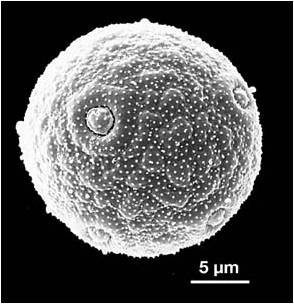 Scanning electron microscopy — Source: Red Palinocam, Comunidad de Madrid
 Description
The genus Plantago includes about 200 herbaceous species, mostly stemless with basal rosette leaves. Common species in Madrid include P. lanceolata, P. major, P. coronopus and P. media. Caulescent species (psyllium group) produce mucilage. Flowers grow in dense spikes with quadripartite calyx and tubular corolla with 4 lobes.
Habitat and distribution
Very common along roadsides, parks, gardens, plots and meadows. Hardy plants that tolerate compacted soils and adverse conditions. Abundant throughout the Madrid region.
Health impact
Pollination from March to June, with peak in April-May. Produces rhinoconjunctivitis and can exacerbate asthma. The Pla l 1 protein is the main allergen.
Cross-reactivity
May show cross-reactivity with grasses and olive (Ole e 1), as they share similar epitopes.
Pollen morphology
Apolar, spheroidal pollen grain, 22-40 μm, pantoporate with 5-16 pores of about 3 μm diameter, each with operculum and annular thickening. Tectate surface with granular supratectal relief.
Did you know?
Plantain has been used in folk medicine as a wound healer and anti-inflammatory. Psyllium species produce a mucilage used as a natural thickener and laxative.
The information on this page is for educational purposes. For any questions about allergies, consult your doctor or allergist.