Poplar
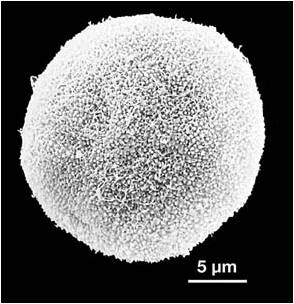 Scanning electron microscopy — Source: Red Palinocam, Comunidad de Madrid
 Description
The genus Populus (family Salicaceae) includes black poplars (P. nigra), white poplars (P. alba) and aspens (P. tremula). Fast-growing deciduous trees reaching 25-30 m. Dioecious, with male flowers in pendant reddish catkins appearing before leaves. Leaves are alternate and variable in shape: rhomboidal in P. nigra, lobulate with white-tomentose underside in P. alba, and rounded with a flattened petiole in P. tremula (causing the characteristic trembling).
Habitat and distribution
Riverbanks, canals and areas with high water table. In Madrid, common in poplar groves along the Manzanares, Jarama, Henares, Tajo and Guadarrama rivers. Lombardy poplar is characteristic of rural avenues.
Health impact
Early pollination (February-March). Low pollen allergenicity. However, the cotton-like seed "fluff" released in April-May causes mechanical irritation of airways and eyes, potentially worsening symptoms in people allergic to other pollens.
Cross-reactivity
Cross-reactivity with willows (Salix), from the same Salicaceae family.
Pollen morphology
Inaperturate (no defined apertures) pollen grain, spheroidal, 25-35 μm. Psilate to finely granular surface. Relatively thick intine. Distinguished under microscopy by its smooth, round appearance without colpi or pores.
Did you know?
The white spring "fluff" from poplars is not pollen but cottony seeds for wind dispersal. The aspen trembles in the slightest breeze due to its laterally flattened petiole.
The information on this page is for educational purposes. For any questions about allergies, consult your doctor or allergist.