Nettle
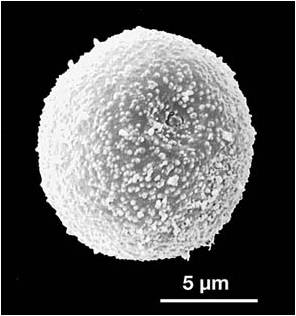 Scanning electron microscopy — Source: Red Palinocam, Comunidad de Madrid
 Description
The Urticaceae family includes nettles (Urtica) and pellitory (Parietaria judaica), the main allergenic species. Pellitory is a perennial herb, 20-80 cm, with soft velvety stems, very leafy with alternate, entire, ovate to oblong-lanceolate leaves. It shows numerous visible cystoliths. Hermaphrodite lateral flowers have 4 stamens; female flowers bear hooked or glandular hairs. Fruit is a 1 mm achene. Stinging nettle (Urtica dioica) is distinguished by its urticant hairs.
Habitat and distribution
Nitrophile plant very common in wall fissures, foot of walls, orchards, urban areas and rubble. Nettles prefer moist, shady areas with nitrogen-rich soils. Both present throughout the Madrid region.
Health impact
Pollination March-July, extending almost year-round in Mediterranean climate. Produces persistent rhinoconjunctivitis and bronchial asthma. The long exposure period makes it particularly burdensome. Main allergen is Par j 1-Par j 2.
Cross-reactivity
Low cross-reactivity with other pollen types. Pellitory has unique, species-specific allergens.
Pollen morphology
Isopolar, oblate-spheroidal pollen grain, 12-17 μm, zoniporate with 3-4 very small pores (sometimes only 1 visible), with oncus. Tectate surface with dense supratectal layer of spines in rugulate arrangement. One of the smallest pollens.
Did you know?
Its name "parietaria" comes from Latin "paries" (wall), because it literally grows on walls. Stinging nettle injects formic acid and histamine through its urticant hairs.
The information on this page is for educational purposes. For any questions about allergies, consult your doctor or allergist.